


Brass vs. Carbon-Lined Synchronizer Rings: Selection Factors for Replacement
Views: 0 Author: Site Editor Publish Time: 2026-10-15 Origin: Site


Gear grind, harsh engagement, and missed shifts often point to a single point of failure in a manual transmission: degraded synchronizer rings. When executing a transmission rebuild, selecting the correct friction material for replacement synchros dictates the gearbox's longevity, shift feel, and thermal capacity. Builders must choose between the proven reliability of traditional OEM materials and the aggressive friction profiles of modern composites.
Evaluating brass vs carbon synchronizer rings requires moving beyond marketing claims and analyzing material science, friction coefficients, thermal limits, base ring construction, and specific application demands. You need to match the friction material to your driving style. Track cars demand different tolerances than daily drivers. This guide breaks down the mechanical realities of both materials. You will learn how to select the right components for your next rebuild based on hard mechanical data and field-tested rebuilding practices.
Application Dictates Material: Brass synchronizer rings provide smooth, predictable engagement for daily driving, while carbon-lined rings offer the high friction coefficient required for high-RPM, high-heat track applications.
Construction Quality Varies: Not all carbon synchros are equal; true performance upgrades utilize full carbon composite linings bonded to rigid steel base rings, rather than superficial carbon/moly spray coatings on brass.
Fluid Compatibility is Critical: The choice between brass and carbon strictly dictates transmission fluid selection, as certain extreme-pressure additives (like sulfur-phosphorus in some GL-5 oils) can corrode yellow metals like brass.
Hybrid Configurations Target Weak Points: Transmission builders often mix materials—utilizing carbon synchros on known weak points (like a notorious 5th gear grind) while retaining brass for other gears to optimize rebuild budgets and shift quality.
How Synchronizer Rings Work: Material Basics
How Synchronizer Rings Function
Synchronizer rings, also called blocker rings, help match the rotational speeds of gears and shafts in manual transmissions. During shifting, the synchronizer sleeve pushes the ring against the gear cone, creating friction that reduces the speed difference.
Once synchronization is achieved, the sleeve can engage the gear teeth smoothly. Worn synchronizer rings may cause gear grinding, difficult shifting, or delayed engagement.
Single vs. Multi-Cone Synchronizers
Single-cone synchronizers use one friction interface to match rotational speeds, while double-cone and triple-cone synchronizers use multiple friction surfaces to increase synchronization capacity.
Multi-cone designs can reduce shifting effort and improve synchronization efficiency in suitable transmission configurations.
Synchronizer Type | Main Feature | Typical Application |
|---|---|---|
Single-Cone | One friction interface, simpler construction | Conventional manual transmissions |
Double-Cone | Additional friction surfaces | Transmissions requiring greater synchronization capacity |
Triple-Cone | Multiple friction interfaces | Selected high-load or performance-oriented transmissions |
The Role of Friction and Heat Dissipation
Synchronizer ring friction materials affect gear engagement, wear resistance, and heat management. During shifting, friction converts the rotational speed difference into heat.
Brass, carbon-lined, and other synchronizer materials have different friction characteristics. Selecting a suitable material helps maintain consistent shifting performance under the intended operating conditions.
Success Criteria for Replacement
A successful synchronizer ring replacement requires accurate part compatibility, suitable friction characteristics, and proper installation.
Technicians should verify the transmission model, gear position, ring dimensions, and lubricant requirements before replacement. Existing gear damage or clutch problems should also be checked to avoid repeated shifting issues.
Brass Synchronizer Rings: The Traditional OEM Standard
Brass synchronizer rings are widely used in manual transmissions because they offer established friction performance, good machinability, and cost-effective manufacturing.
Material Properties and Engineering Design
Brass and bronze alloys provide suitable friction and wear characteristics for many conventional synchronizer designs.
Some rings feature precision-machined grooves or friction surfaces that help manage the lubricating oil film during synchronization.
Explore our Synchronizer Ring Products for manual transmission replacement applications.
Ideal Use Cases
Brass synchronizer rings are commonly suitable for:
OEM-style manual transmission repairs.
Standard passenger vehicles.
Daily driving and general road applications.
Cost-conscious gearbox rebuilds.
They are particularly appropriate when the original transmission design specifies brass or bronze synchronizer components.
Limitations and Wear Factors
Brass synchronizer rings can experience friction surface wear during repeated shifting. High operating loads, unsuitable transmission fluid, and damaged mating components may accelerate deterioration.
Common symptoms include gear grinding, difficult engagement, and reduced synchronization efficiency.
Replacement should be based on component inspection and manufacturer-specified wear limits rather than material type alone.
Brass vs. Carbon-Lined Synchronizer Rings: Basic Selection
Evaluation Factor | Brass Synchronizer Rings | Carbon-Lined Synchronizer Rings |
|---|---|---|
Material | Brass or bronze alloy | Carbon-based friction lining |
Main Advantage | Established OEM performance | Specialized friction characteristics |
Typical Use | Conventional manual transmissions | Selected performance applications |
Wear Resistance | Depends on alloy and operating conditions | Depends on lining design and operating conditions |
Cost | Generally lower | Generally higher |
Selection Priority | OEM compatibility | Verified transmission compatibility |
Carbon-Lined Synchronizer Rings: The Performance Upgrade
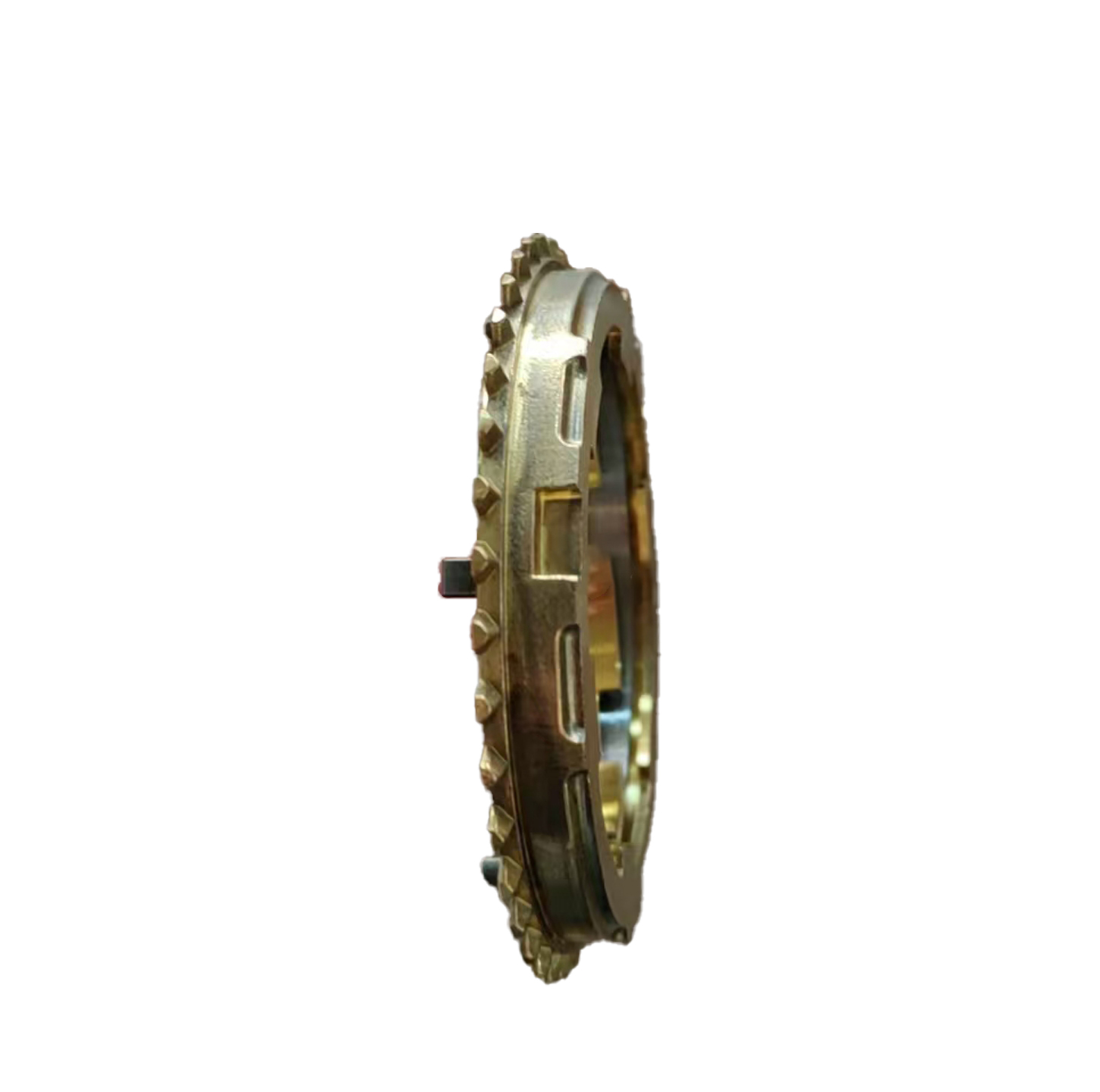
Carbon-lined synchronizer rings use specialized friction materials to improve synchronization performance in compatible manual transmissions. Compared with conventional brass rings, carbon-lined designs may offer advantages in friction stability and wear resistance under demanding operating conditions.
Base Ring Construction (Steel vs. Brass)
Carbon-lined synchronizer rings may use steel or other suitable base materials to support the friction lining. Steel substrates can provide structural rigidity, while brass-based designs have different mechanical characteristics.
The appropriate construction depends on the transmission design, operating loads, and manufacturing specifications.
Carbon Composite vs. Spray Coating
Carbon composite linings and thin friction coatings use different manufacturing methods.
Bonded carbon composite materials may provide favorable wear characteristics in suitable applications, while coated surfaces depend on coating thickness, adhesion quality, and material formulation.
Buyers should verify friction performance, coating durability, and compatibility rather than assuming one construction is always superior.
Performance and Thermal Advantages
Carbon-lined synchronizers can provide stable friction characteristics under repeated shifting and elevated operating temperatures.
However, actual improvements in synchronization speed, wear resistance, and shifting performance depend on the lining formulation, gear geometry, and transmission lubricant.
Ideal Use Cases
Carbon-lined synchronizer rings may be suitable for:
Performance-oriented manual transmissions.
High-frequency shifting applications.
Selected heavy-duty gearboxes.
Transmission rebuilds requiring specialized friction materials.
For standard replacement applications, explore our Transmission Synchronizer Rings to find compatible components.
Brass vs. Carbon Synchronizer Rings: Head-to-Head Evaluation
Brass and carbon-lined synchronizer rings differ in friction characteristics, material construction, cost, and application requirements. Neither material is universally better for every transmission.

Shift Quality and Engagement Feel
Brass synchronizer rings are widely used in conventional manual transmissions and can provide smooth synchronization when correctly matched to the gearbox.
Carbon-lined designs may offer different friction characteristics that support demanding shifting conditions. Actual shift feel depends on the complete synchronizer assembly and transmission design.
Thermal Capacity and Longevity Under Load
Carbon-lined friction materials may provide improved thermal and wear performance in selected high-load applications.
Brass rings remain a practical choice for many standard transmissions. Service life depends on driving conditions, material quality, lubrication, and component compatibility.
Transmission Fluid Compatibility
Synchronizer ring performance is closely related to transmission lubricant properties.
Brass and carbon-lined rings may require different friction characteristics from the specified oil. Some lubricant additives can also affect copper-alloy compatibility.
Always follow the transmission or component manufacturer's fluid recommendations.
Cost-to-Performance Ratio
Brass synchronizer rings are generally a cost-effective choice for standard replacement applications.
Carbon-lined rings may require a higher investment but can be worthwhile where their performance characteristics are needed and the transmission supports the upgrade.
Brass vs. Carbon Synchronizer Ring Comparison
Evaluation Factor | Brass Synchronizer Rings | Carbon-Lined Synchronizer Rings |
|---|---|---|
Friction Material | Brass or bronze alloy | Carbon-based friction lining |
Typical Application | Standard manual transmissions | Selected performance and heavy-duty applications |
Thermal Performance | Suitable for intended OEM conditions | May offer advantages under higher thermal loads |
Wear Resistance | Depends on alloy and operating conditions | Depends on lining formulation and bonding |
Shift Performance | Established OEM characteristics | Application-specific friction response |
Lubricant Compatibility | Requires suitable transmission fluid | Requires lining-compatible lubricant |
Cost | Generally lower | Generally higher |
Key consideration: Material selection should prioritize transmission compatibility and verified performance rather than friction material alone.
Mixed Material Rebuild: Combine Brass and Carbon Rings
Some transmission rebuilds may use different synchronizer ring materials for different gears. However, mixed-material synchronizer upgrades should only be considered when supported by the transmission design and component specifications.
Targeting Specific Gear Vulnerabilities
Certain gear positions experience greater synchronization demands because of operating speed, rotational inertia, and shifting frequency.
Where compatible components are available, builders may evaluate carbon-lined rings for selected high-load positions while retaining suitable original materials elsewhere.
Balancing the Rebuild Budget
A targeted replacement strategy can help control transmission rebuild costs.
Instead of upgrading every synchronizer ring, technicians should inspect component wear, review available material options, and determine whether specialized friction linings provide measurable benefits.
Rebuild Risks and Prevention Methods
Synchronizer ring replacement requires accurate part identification, dimensional verification, and appropriate installation procedures. Incorrect components can cause gear grinding, difficult shifting, or premature wear.
OEM vs. Aftermarket Dimensional Accuracy
Both OEM and aftermarket synchronizer rings should meet the required transmission specifications.
Important factors include ring diameter, cone angle, friction surface design, and engagement geometry.
For replacement applications, explore our Hyundai 43350-02502 Synchronizer Ring. Buyers should verify the OE number and transmission compatibility before ordering.
Clearance and Tolerance Verification
Synchronizer ring clearance should be measured according to the relevant transmission service manual.
Technicians should inspect the gear cone, friction surface, and engagement teeth before assembly. Required clearances vary by transmission model, so universal measurements should not replace manufacturer specifications.
Break-in Procedures
After a transmission rebuild, operators should follow the component or vehicle manufacturer's instructions for lubrication, initial operation, and inspection.
Some replacement components may require specific initial operating procedures, but a universal mileage-based break-in or mandatory fluid change should not be assumed.
Conclusion
Choosing between brass and carbon-lined synchronizer rings depends on transmission design, operating conditions, friction requirements, and replacement costs.
Brass rings remain suitable for many standard manual transmissions, while carbon-lined materials may offer advantages in selected performance applications.
For reliable replacement, buyers should verify OE references, component dimensions, friction material compatibility, and specified transmission fluids.
Explore our Synchronizer Ring Products to find suitable manual transmission replacement components.
FAQ
Q: Do carbon synchronizers wear out faster than brass?
A: No. Under high heat and aggressive shifting, carbon composites outlast brass significantly. However, poor-quality carbon spray coatings can flake and fail quickly. Genuine woven carbon linings bonded to steel rings offer superior longevity in demanding environments.
Q: Can I use standard gear oil with carbon synchros?
A: Not always. You must check the manufacturer's fluid recommendations. Carbon composites often require specific synthetic friction-modified fluids. Using the wrong oil can glaze the carbon surface, causing it to lose its friction coefficient and grind.
Q: Why do my gears grind only at high RPMs?
A: High-RPM grinding relates directly to thermal and friction limitations. Worn brass rings lose their inner threads. They can no longer cut through the oil fast enough to speed-match the massive RPM differential, resulting in a dog teeth clash.
Q: Are carbon-coated synchros the same as carbon composite?
A: No. Carbon-coated synchros feature a thin spray layer over a standard brass ring. Carbon composite synchros utilize a thick, woven carbon material physically bonded to a rigid forged steel base ring. Composites are vastly superior.
Q: Can I mix brass and carbon synchros in the same transmission?
A: Yes. Hybrid setups are extremely common and highly effective. Builders often use carbon on known weak gears while retaining brass on multi-cone lower gears to balance performance, cost, and shift feel.
Q: Will carbon synchros fix a damaged gear cone?
A: No. No synchro material can compensate for a physically damaged, blued, or heavily scored gear engagement cone. The gear cone provides the mating surface. If it is damaged, you must replace the entire gear.


